Flex Industrial Roofing in New Haven, CT
Flex Industrial Roofing
Review flex-industrial roofs near New Haven for tenant transitions, equipment penetrations, drainage, loading access, and phased capital work.
A flex building can put light production, office suites, storage, and loading under one roof, with each tenant using the space differently. New Haven's repeated winter freezes make drainage and perimeter transitions practical items to inspect before the next budget cycle. We document the assembly, map active defects, and separate shared roof work from tenant-specific access or equipment coordination.
East Haven includes warehousing, wholesale distribution, electronic components, and industrial fabrication in its commercial mix. Hamden also has computer products, cable, concrete equipment, and fabricated metals. Those regional uses inform the kinds of operations nearby, while a field review confirms the actual roof system and tenant layout.
Tenant boundaries and shared roof details
Interior demising lines rarely match the boundaries of roof sections. A leak reported by one tenant may trace to a drain or curb serving several units, so we review the roof as a connected assembly. Our report marks the opening, the interior location, and any shared component that requires landlord approval or a separate trade.
Where suites have separate rooftop units or exhausts, the scope should identify who controls shutdown and access. We record equipment locations and transitions that may need a coordinated visit. A property management roof program can keep repair files consistent across suites, while warehouse roof planning addresses a different mix of loading and storage needs.
For a multi-tenant property, the owner should identify whether maintenance requests flow through one manager or separate tenant contacts. We can prepare a shared condition map and keep each interior report limited to the relevant area. This helps the general contractor distinguish a landlord-controlled roof repair from a tenant's equipment concern and track approvals that affect work dates.
When several tenants occupy a single roof section, scope language should avoid dividing membrane work by suite line unless the assembly supports that boundary. We mark the physical repair area and show which units or common spaces lie below. The owner can decide how to communicate the work while bids remain grounded in the same roofing limits.
Penetrations and changing rooftop use
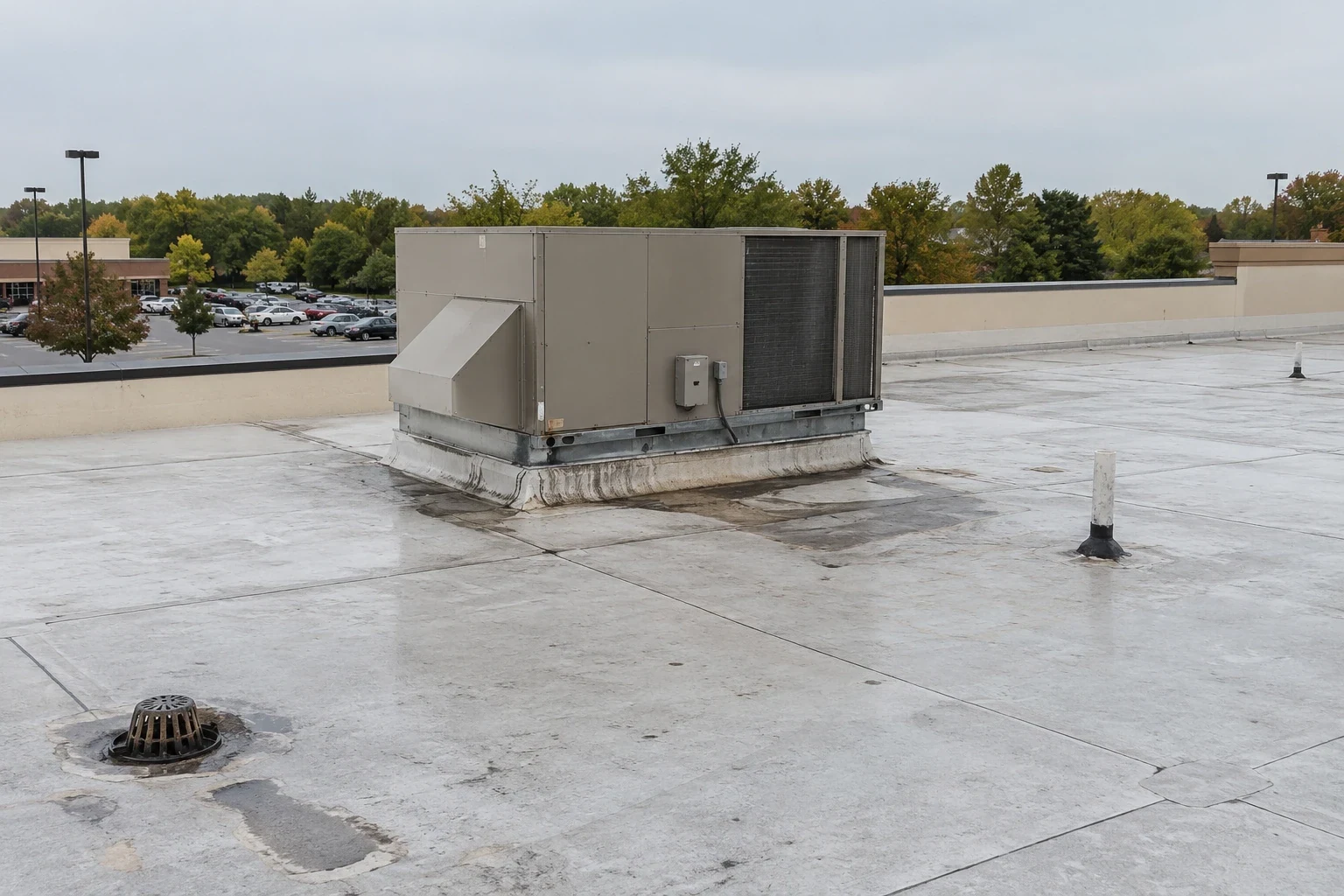
Flex tenants may install new exhausts, conduits, satellite supports, or service lines over time. Each new opening changes the roof detail and can interrupt drainage or invalidate an earlier repair boundary. We compare current penetrations with roof drawings, photograph the flashing, and ask the general contractor to identify abandoned equipment that may be removed or left in place.
A properly scoped repair includes membrane preparation, compatible flashing, secure termination, and any tie-in needed around the curb. Sealant alone may cover a symptom while leaving a loose or poorly lapped transition. Where the roof contains several membrane types or additions, we list them separately. An equipment curb review can define the interface, and a flashing repair scope can keep that work visible in bid comparison.
Roof replacements and tenant improvements may occur in separate contract packages. We identify existing penetrations, the proposed locations of new work when available, and the sequence for closing each opening. If a tenant plans new equipment after the roofing phase, the owner should coordinate a compatible curb and flashing detail before the membrane is installed.
Abandoned curbs deserve a decision too. Removing one can leave a deck opening and require structural closure, insulation replacement, and a new membrane tie-in. Leaving it in place may preserve the deck but still requires secure, watertight capping. We document the alternatives and any trade input needed before a bid includes the work.
Drainage on mixed-use roof areas
Low areas, roof drains, scuppers, and gutters need to work with the slope and each tenant's equipment footprint. We trace discharge from roof surface to outlet, record debris or a damaged connection, and identify where a neighboring trade controls interior piping. If water sits near a tenant's unit, the report should show whether the concern is local ponding, a blocked outlet, or an opening at a nearby detail.
New Haven's winter freezes put the drainage path on the inspection list for flex roofs. We photograph observed conditions and recommend cleaning, repair, further testing, or routine monitoring based on what the inspection shows. A drainage review can isolate outlet work from a broader roof repair. The owner can then assign the correct scope without combining every water issue into one undefined line item.
Loading, deliveries, and phased access
Flex-industrial tenants may depend on loading docks, receiving hours, forklifts, and clear fire lanes. We confirm truck routes, lift positions, material storage, and temporary closures before setting a work sequence. If a phase crosses an active dock, the project plan names the window and the route that remains open, giving the tenant time to move scheduled deliveries.
New Haven is connected by passenger transit, freight rail, and motor carriers, and those links support regional movement of people and goods. They do not tell us how a particular property receives materials. We verify truck access on site. A phased reroof plan can separate sections by tenant or operation, while work near East Haven must fit the property manager's actual delivery plan.
Repair threshold and roof history
One isolated curb failure may call for a targeted repair; recurring leaks across different suites can point to a wider system question. We compare roof age records, repair invoices, moisture evidence, and current attachment observations. The proposal states the boundary of known work and what additional test would shift the recommendation from repair to restoration or replacement.
For a capital decision, the general contractor can compare restoration with replacement where the assembly supports both. We include staging, tenant protection, temporary dry-in, edge metal, and roof curb work in the alternatives. A self-storage roof scope also depends on unit access, but its circulation plan differs from a flex site with active loading and shop operations. A useful record leaves owners with clear deferrals and repeatable observations.
Some roof choices turn on recoverability. We check how many existing layers are present, whether moisture is confined or widespread, and whether the substrate can accept another system. A recover can reduce tear-off but cannot correct a weak deck or resolve a saturated assembly. The scope states these conditions before comparing the option with full replacement.
Budget timing can also reflect tenant turnover or planned fit-outs. If a space will be vacant soon, the owner may have a better opportunity for noisy work or interior confirmation. We record those windows as schedule inputs, not as proof that the roof should wait. The responsible choice remains tied to current water entry, safety, and assembly condition.
Questions Owners Ask
Can a landlord repair the roof without entering every suite?
Often the roof work itself does not require suite access, but leak tracing or equipment shutdown may. We identify which locations require an interior check, coordinate with the tenant contact, and state when exterior evidence is enough. That avoids a blanket access request where only one area needs coordination.
How should new rooftop equipment be handled in a repair bid?
List each curb, line, and support that intersects the roof, then confirm who owns disconnection and resetting. We document the flashing and membrane around it and identify any abandoned item. A clear responsibility split prevents a new penetration from being left without a completed watertight detail.
What does freezing weather change for a flex roof?
It makes drainage and open transitions worth checking, especially where water can collect near equipment or walls. We still rely on the actual roof examination to establish a defect. The condition record distinguishes a weather-related priority from a confirmed repair need.
Can work move around tenant loading schedules?
We set the sequence around truck access, dock use, staging, and safe separation. The project can proceed by roof zone when the condition and weather allow, with a stated hand-back point for each area. The owner can provide tenant windows before the work dates are confirmed.
When should ownership consider replacement instead of repeated repairs?
A pattern involving multiple roof areas, repeated water entry, or wet insulation can broaden the decision. We compare those findings with prior repairs and system condition, then show which areas remain serviceable and what evidence would change the scope. Replacement is weighed against restoration, access, and capital timing.